Ask any early childhood educator what the single most important thing a young child can do, and chances are the answer will surprise you: play. Not flashcards, not worksheets, not structured drills — just play. But there is nothing “just” about it. Play is the primary way children under six build the neural pathways that every future skill — reading, maths, empathy, resilience — grows from.
What the Science Says
During the first six years of life, a child’s brain forms more than one million new neural connections every single second. The quality and type of experiences a child has directly shapes which of those connections are strengthened and which are pruned away. Research consistently shows that child-directed, open-ended play produces the richest, most densely connected networks in areas governing language, executive function, and social-emotional regulation.
A child building a block tower is not “just playing” — they are experimenting with physics, practising persistence when the tower falls, negotiating with a friend about who gets the red block, and narrating their decisions out loud. That single activity exercises at least five developmental domains simultaneously. No worksheet can do that.
What “Foundation” Really Means
We talk about strong foundations in early education, but what does that actually look like? Think of it as four pillars your child is quietly constructing every time they engage in free or guided play:
1. Executive Function
Games with rules — even simple ones like “the floor is lava” — demand self-regulation, impulse control, and working memory. These are the very skills that predict academic success more reliably than IQ. A child who can wait their turn, hold a plan in mind while executing it, and shift strategy when something isn’t working is a child built for lifelong learning.
2. Language and Literacy
Pretend play is a language laboratory. When children assign roles (“you be the patient, I’ll be the doctor”), negotiate plot (“no, the dinosaur is friendly this time”), and narrate action, they practise complex sentence structures, build vocabulary, and develop narrative comprehension — the precise skills they’ll need to decode and understand text in school.
3. Emotional Regulation
Losing a board game. Not getting the toy they wanted. Being excluded from a pretend tea party. These small moments of disappointment inside the safe container of play are where emotional regulation is learned. Children practise managing frustration, disappointment, and excitement in low-stakes situations so those skills are available when the stakes are higher.
4. Curiosity and a Growth Mindset
Open-ended play has no right answer and no failure — only new questions. A child who regularly experiences the delight of discovery (“What happens if I mix the blue and yellow paint?”) internalises the idea that effort leads to interesting outcomes. That is the bedrock of a growth mindset.
How Waddle Kids Makes It Intentional
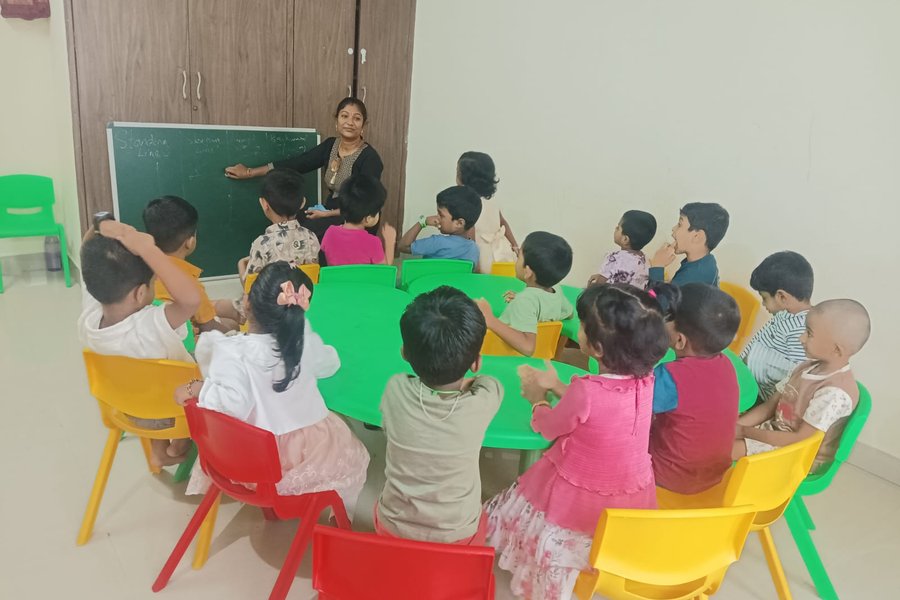
At Waddle Kids, play-based learning is not a free-for-all. Our educators create carefully designed environments and provocations — open-ended materials, mixed-age interactions, and gentle guided questioning — that stretch each child’s play into their zone of proximal development. We observe, document, and respond to each child’s interests so that the play is always meaningful, challenging, and joyful.
The result is children who arrive at primary school not just “school-ready” in a checklist sense, but genuinely in love with learning — curious, confident, and capable of navigating the challenges ahead.